This guide is for teachers. It shows how to take attendance, give grades, schedule exams, post homework and keep in touch with students and families.
You see the classes your school has placed you in, and the students and parents of those classes. If a class or a student is missing, ask your school office — they manage classes.
Signing in
Shkolla.app runs in your web browser — there is nothing to install. It works on computers, tablets and phones.
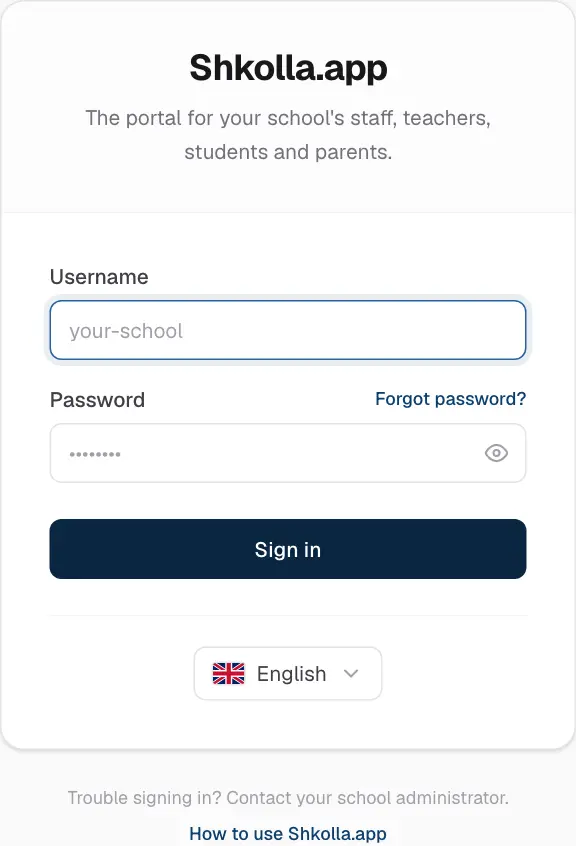
Open portal.shkolla.app in your browser.
Choose your language at the bottom of the sign-in card. The app remembers it next time.
Enter your Username and Password.
Click Sign in.
The sign-in page.
Forgot your password?
Contact your school office. They can set a new password for you in a moment. For your security, personal accounts can't be reset by email.
Finding your way around
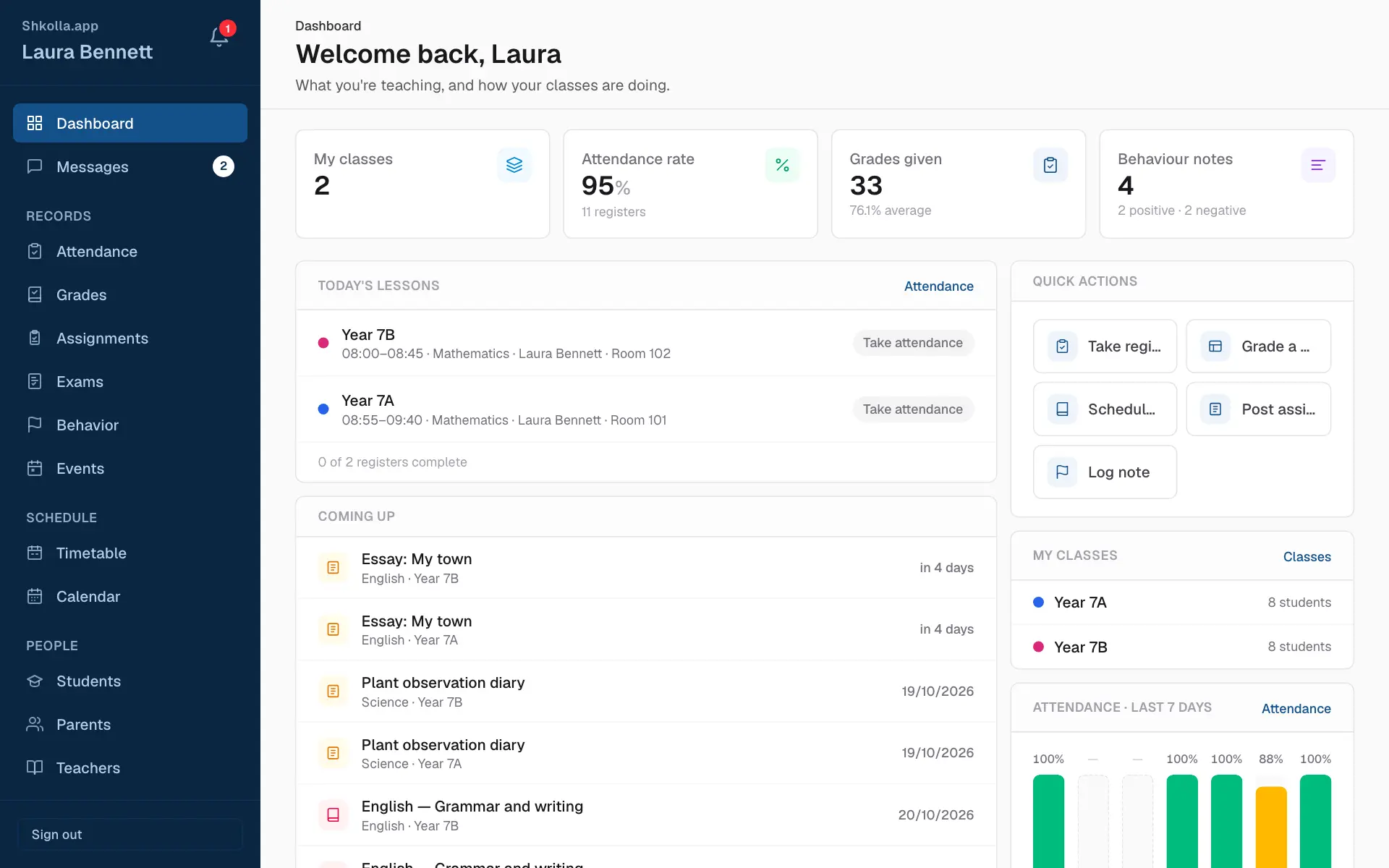
After signing in you land on your Dashboard — a summary made just for you. Everything else is in the sidebar on the left.
Your dashboard and sidebar.
The sidebar lists the pages meant for you, in groups. The page you're on is highlighted.
The bell at the top shows your notifications. A red number counts the unread ones.
Messages opens your conversations. The number beside it counts unread messages.
Sign out is at the bottom. Always sign out on a shared device.
You only ever see what you're allowed to see — your own records, your children's or your classes'. Pages you can only read have no add or edit buttons.
On your phone
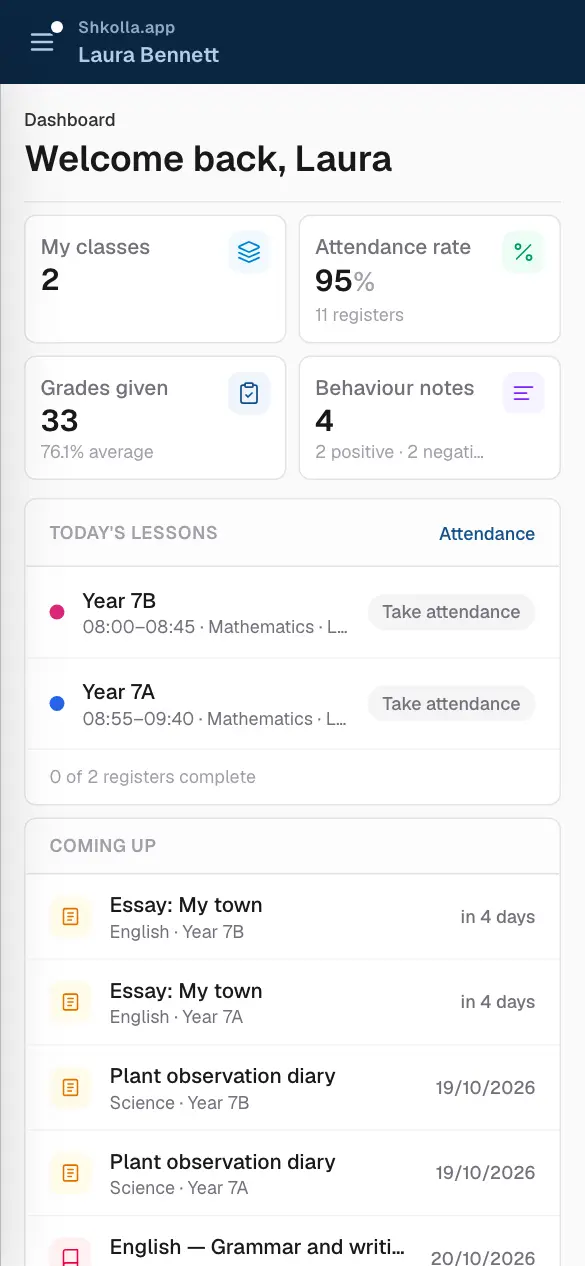
On a phone the sidebar folds away. Tap the menu button (☰) at the top left to open it, then tap a page.
Shkolla.app on a phone.
02
Your day
Your dashboard
Your dashboard is your day.
A teacher's dashboard.
The numbers at the top — your classes, their attendance rate, grades you've given this month and behaviour notes.
Today's lessons — your lessons today and whether each register is done. Take attendance opens it.
Coming up — your next exams and assignment due dates.
Quick actions — take a register, grade a class, schedule an exam, post an assignment or log a note in one click.
My classes and attendance over the last seven days.
Taking attendance
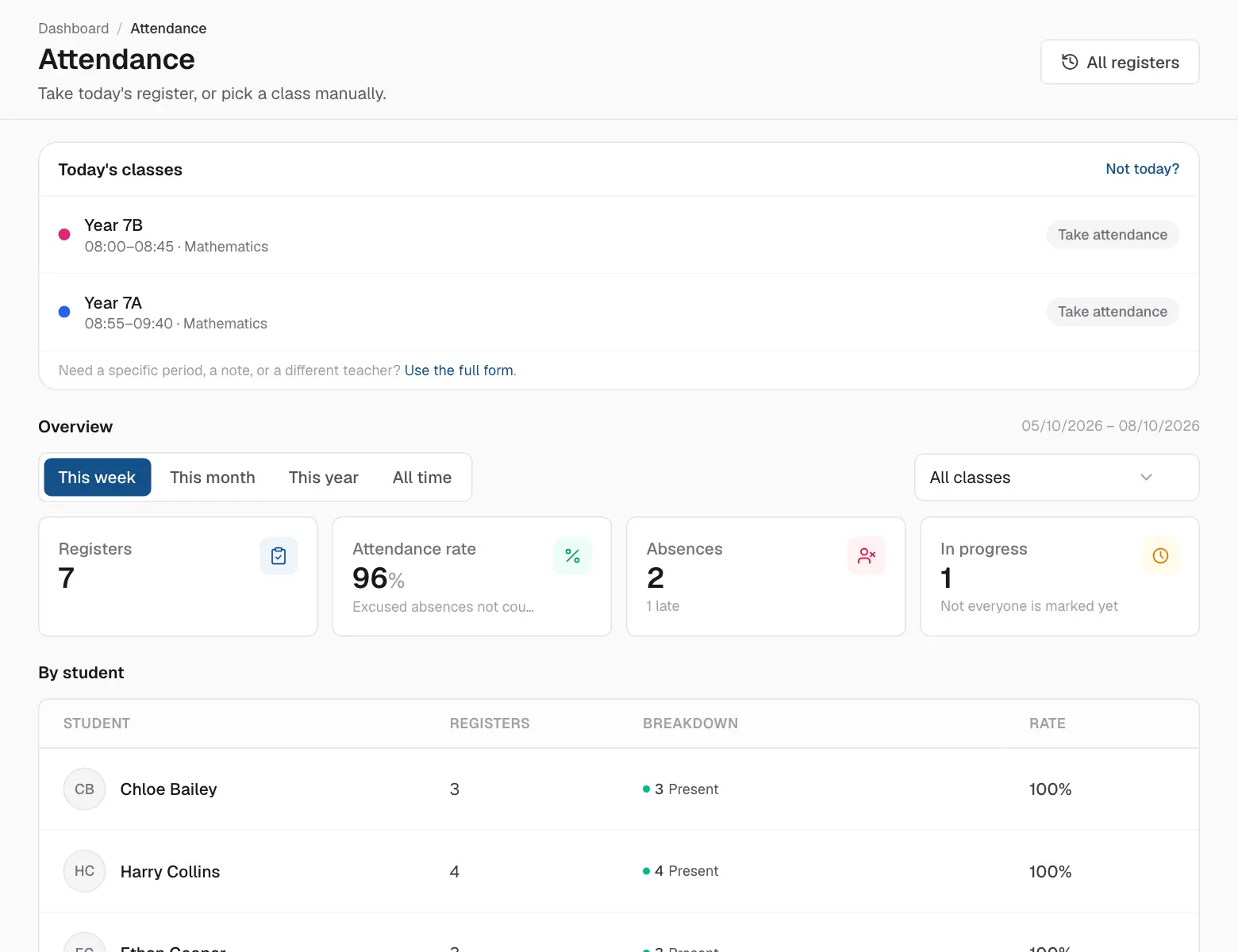
Your lessons for today are waiting at the top of Attendance (and on your dashboard).
Today's lessons.
Click Take attendance beside the lesson.
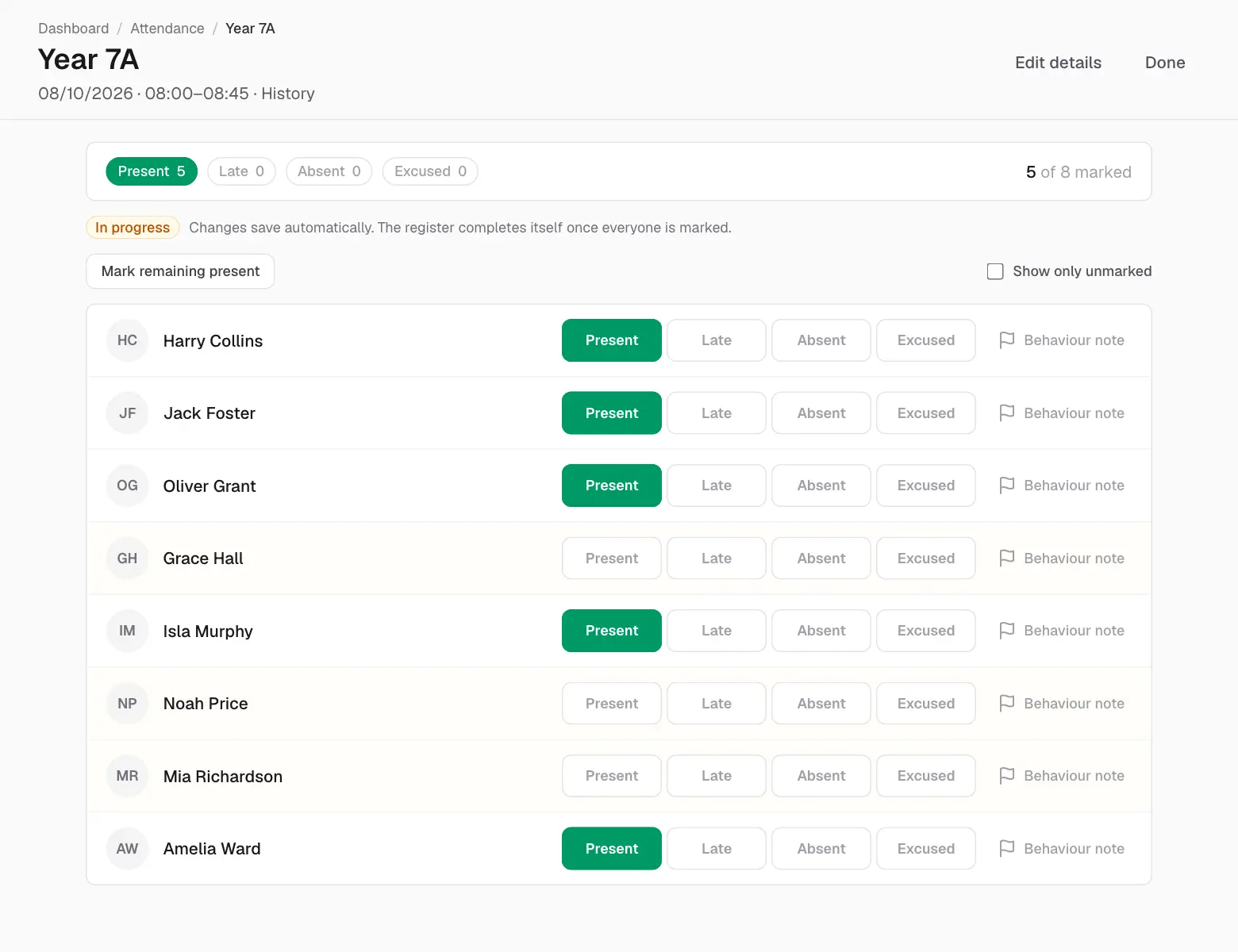
Mark each student Present, Late, Absent or Excused. Mark remaining present marks everyone left in one click.
Done — every click is saved instantly. The register completes itself once everyone is marked.
Taking a register.
The flag beside a student adds a behaviour note without leaving the register.
Not today? opens a register for another day or lesson.
Show only unmarked hides students you've already marked — handy in a big class.
03
Grades, exams and homework
Giving grades
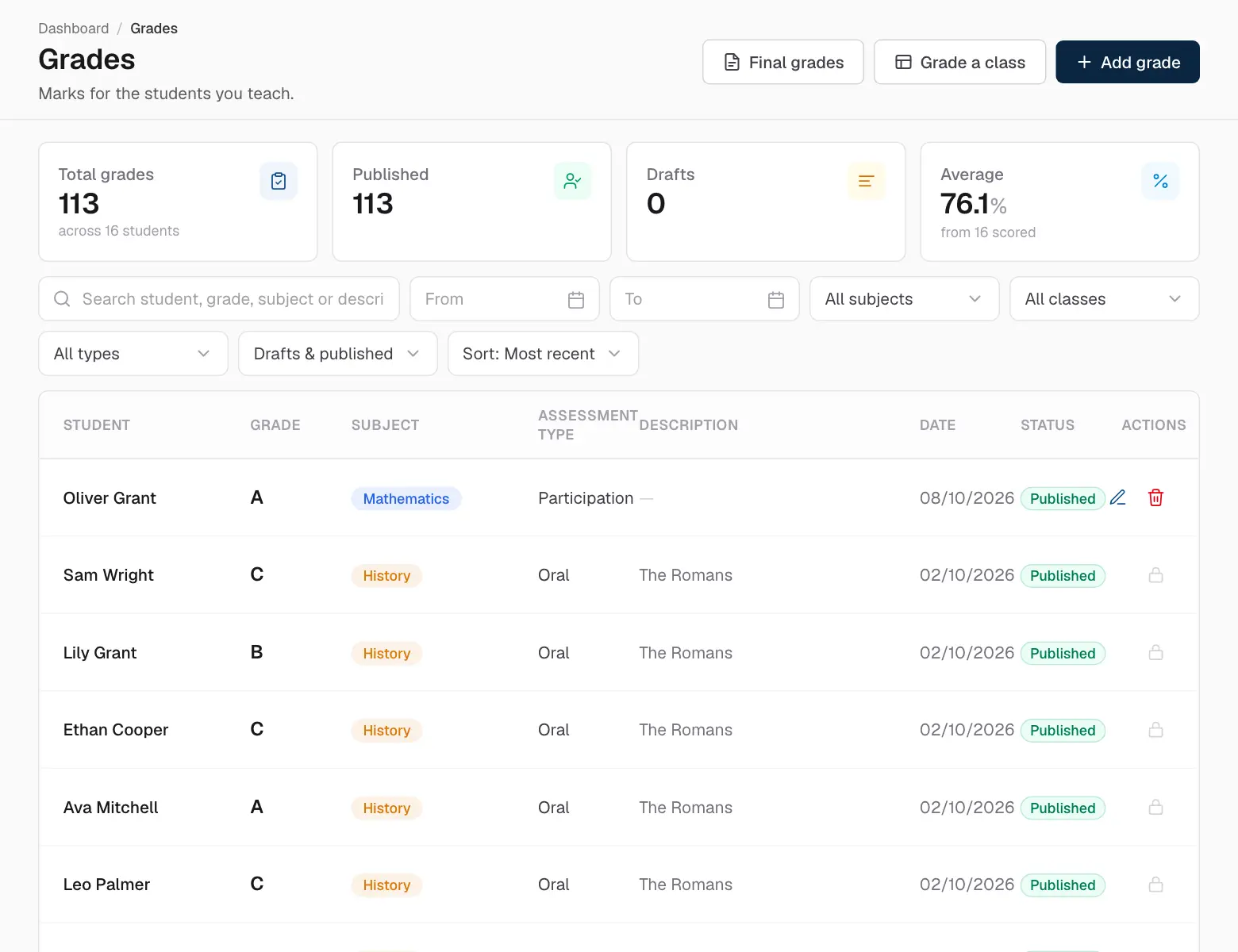
Grades lists the marks you've given, with search and filters by subject, class and type.
Your grades.
Click Add grade to grade one student.
Choose the student, subject, type and mark — and a score if you use points.
Choose Published (the student and parents see it at once) or Draft (private until you publish).
Save.
Grading a whole class
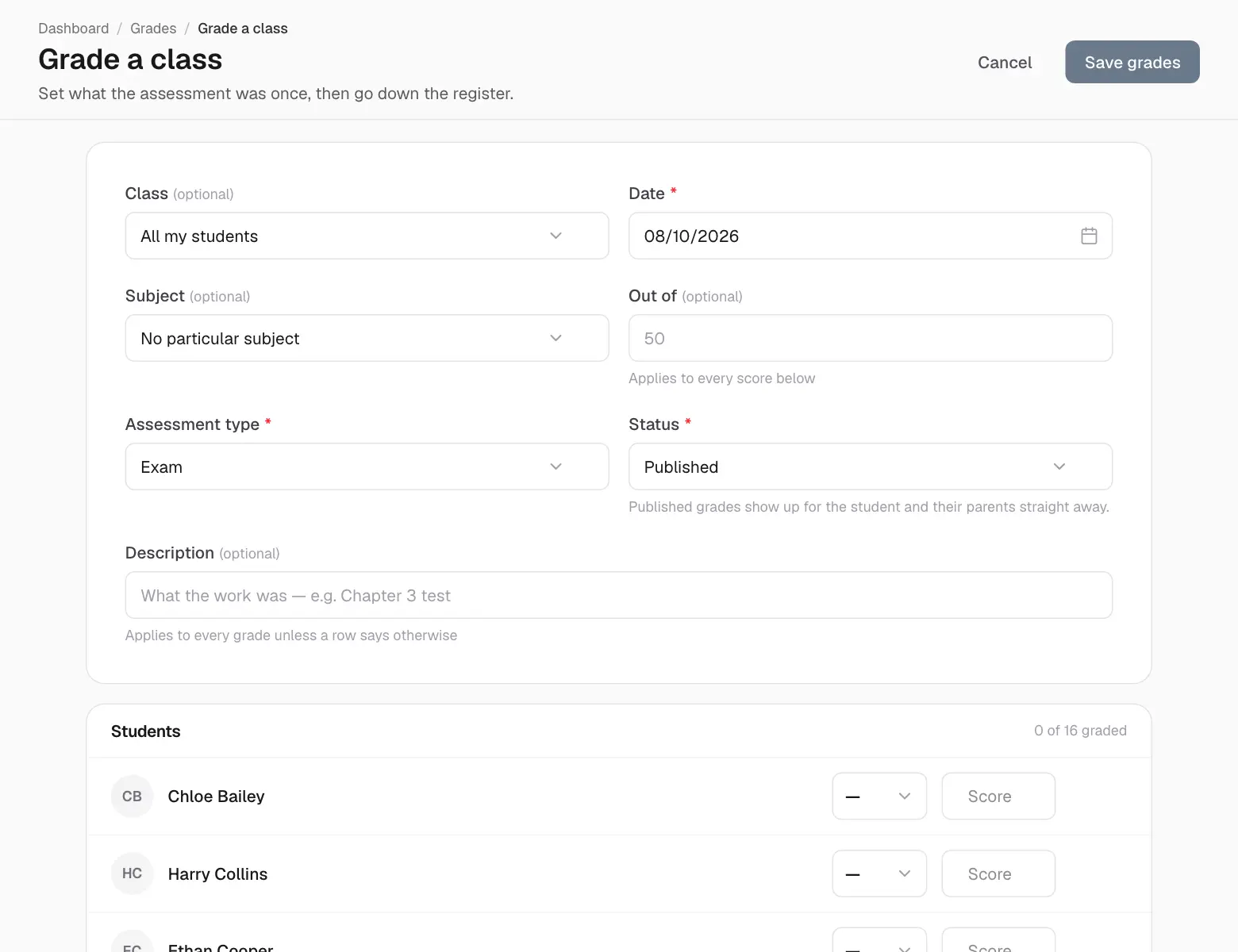
Grade a class is the fastest way to mark a test: describe it once, then go down the list.
Click Grade a class (on Grades or on the dashboard).
Choose the class, subject, date and type — and the maximum score if you use points.
Enter each student's mark and/or score.
Click Save grades.
Grading a class in one go.
Final grades and report cards
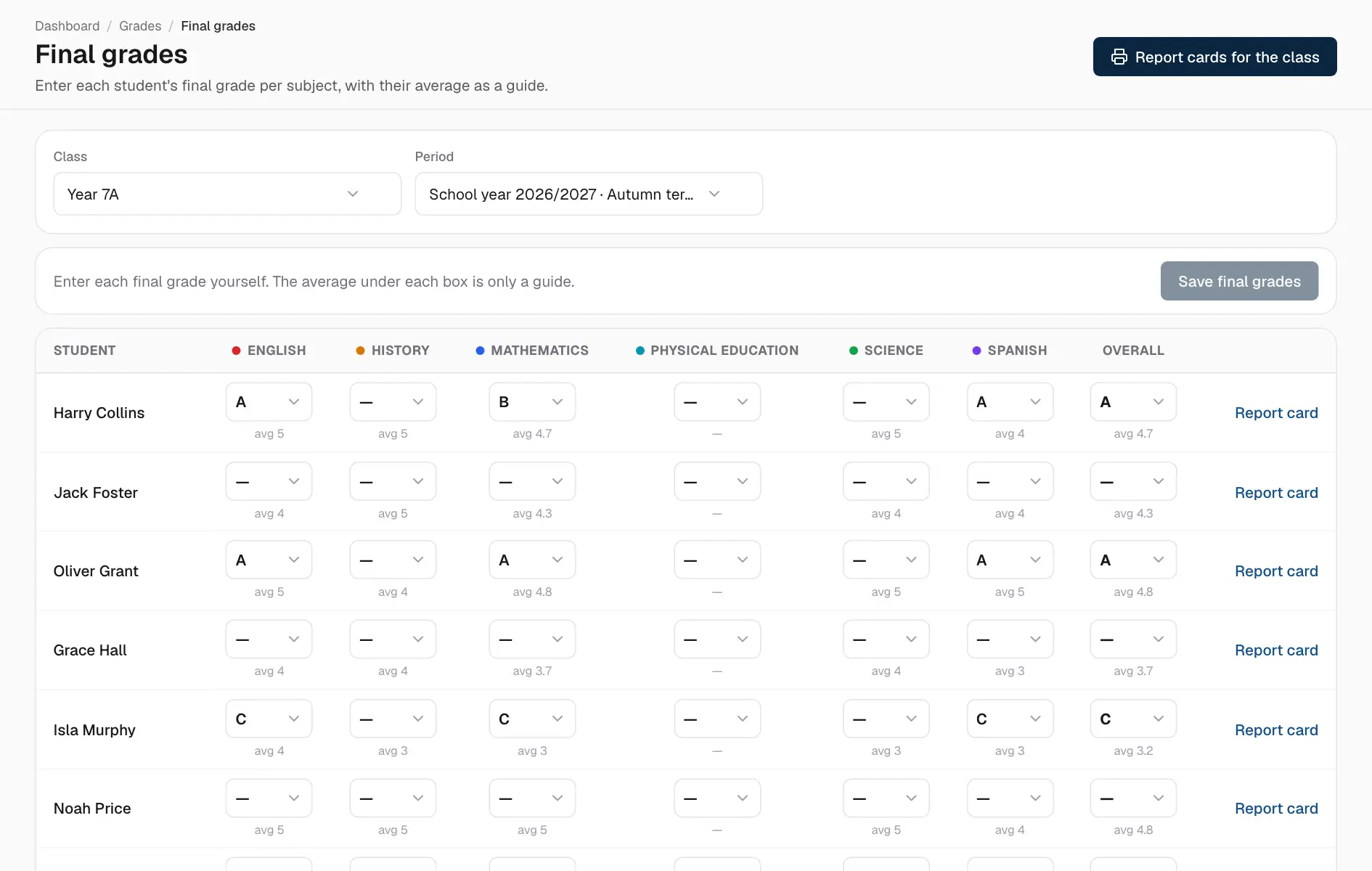
At the end of a term, Final grades shows your students' averages per subject so you can give their final grades.
On Grades, click Final grades.
Choose your class and the period.
Enter each final grade — the average under each box is only a guide.
Click Save final grades.
Final grades for a class.
Each student's Report card — averages, final grades and attendance — is one click away, ready to print.
Exams
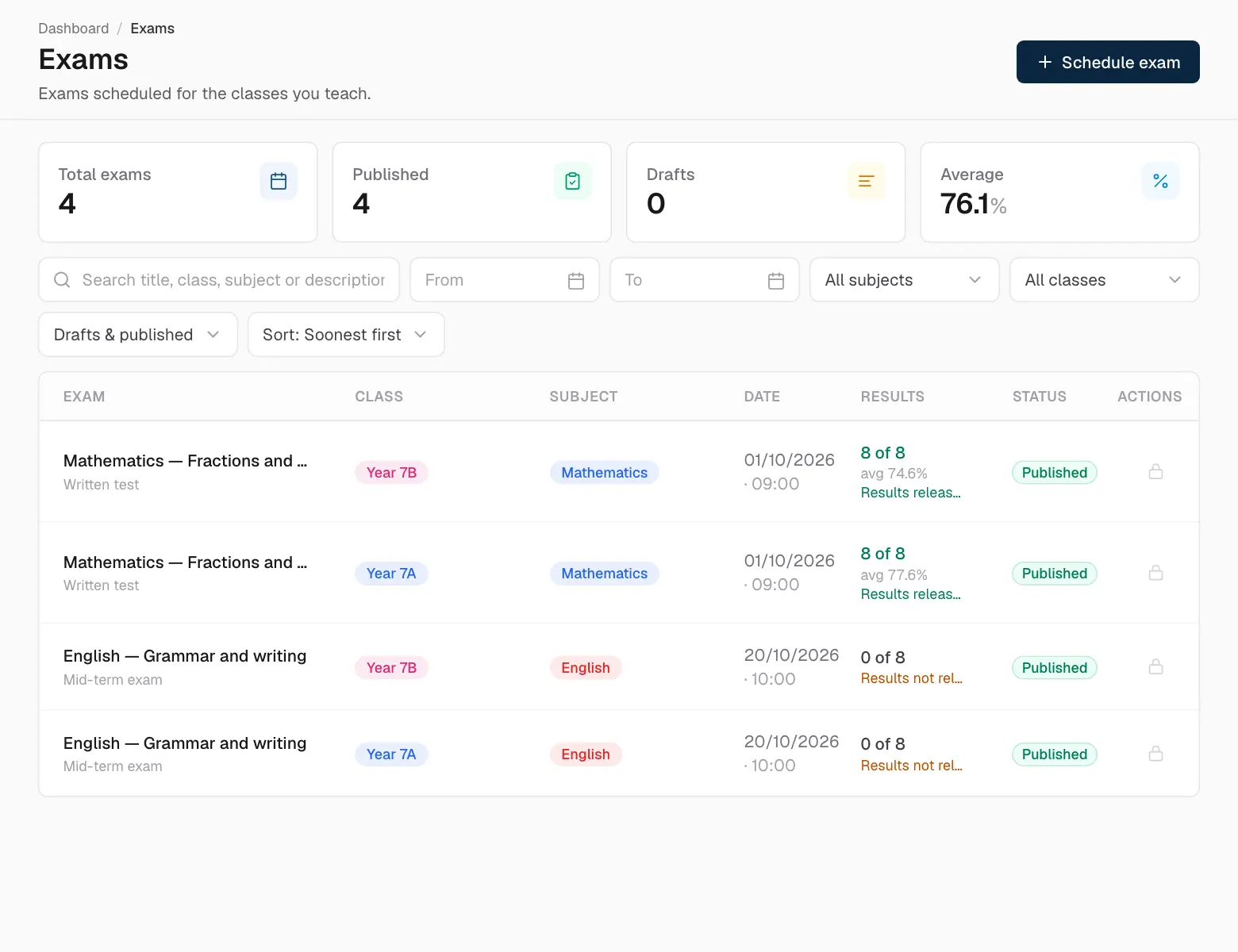
Schedule exams in advance so your students and their parents see them coming. The results you enter become grades automatically.
On Exams, click Schedule exam.
Choose the class and subject, then the title, type, date and time — and if you like a maximum and passing score.
Save. It appears for every student in the class.
Your exams.
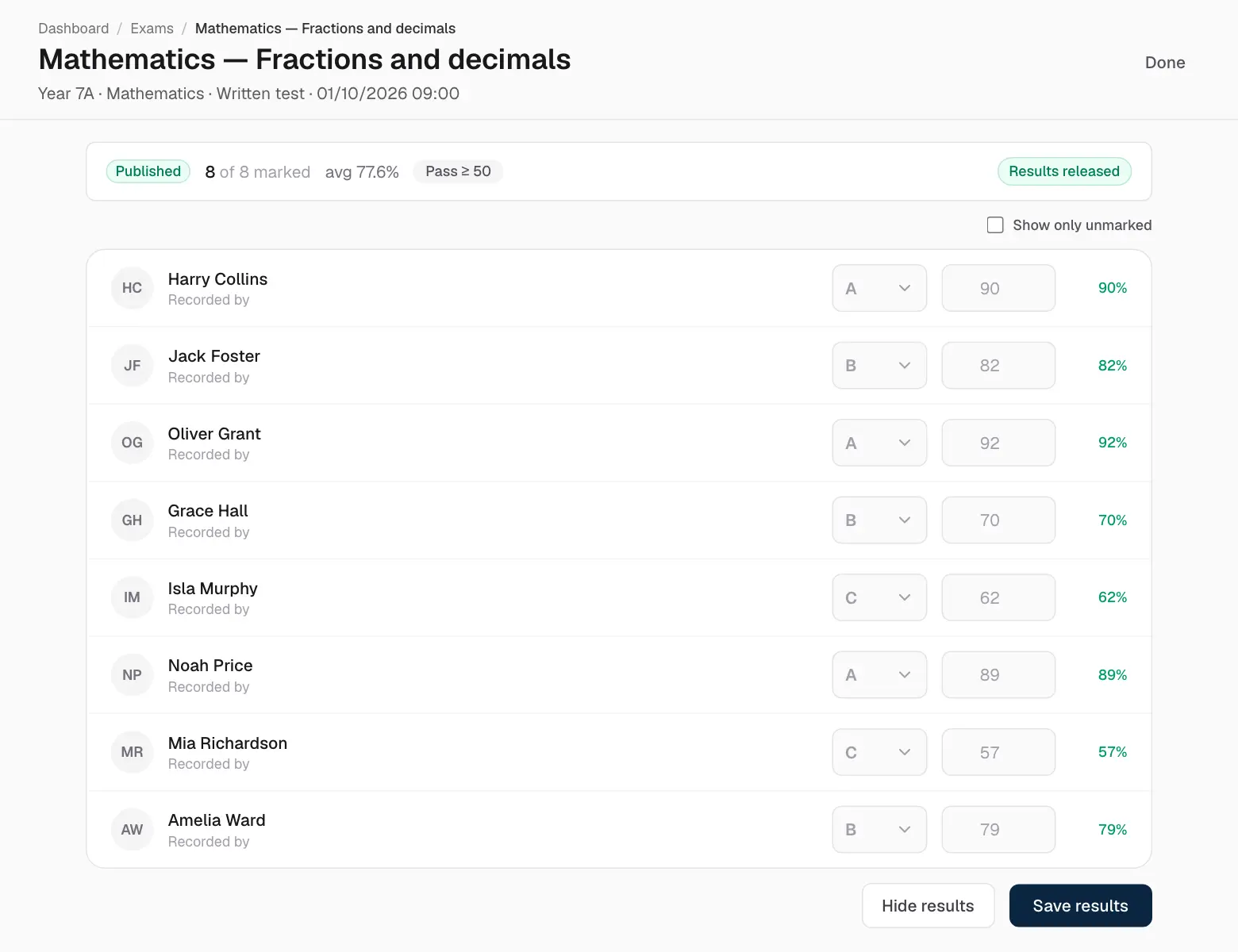
After the exam, open it and enter each student's score and/or mark — the percentage and pass or fail colour are calculated for you.
Entering results.
Save results saves the results privately.
Save & release results shows them to students and parents (and sends them a notification).
Hide results hides released results again.
Homework and assignments
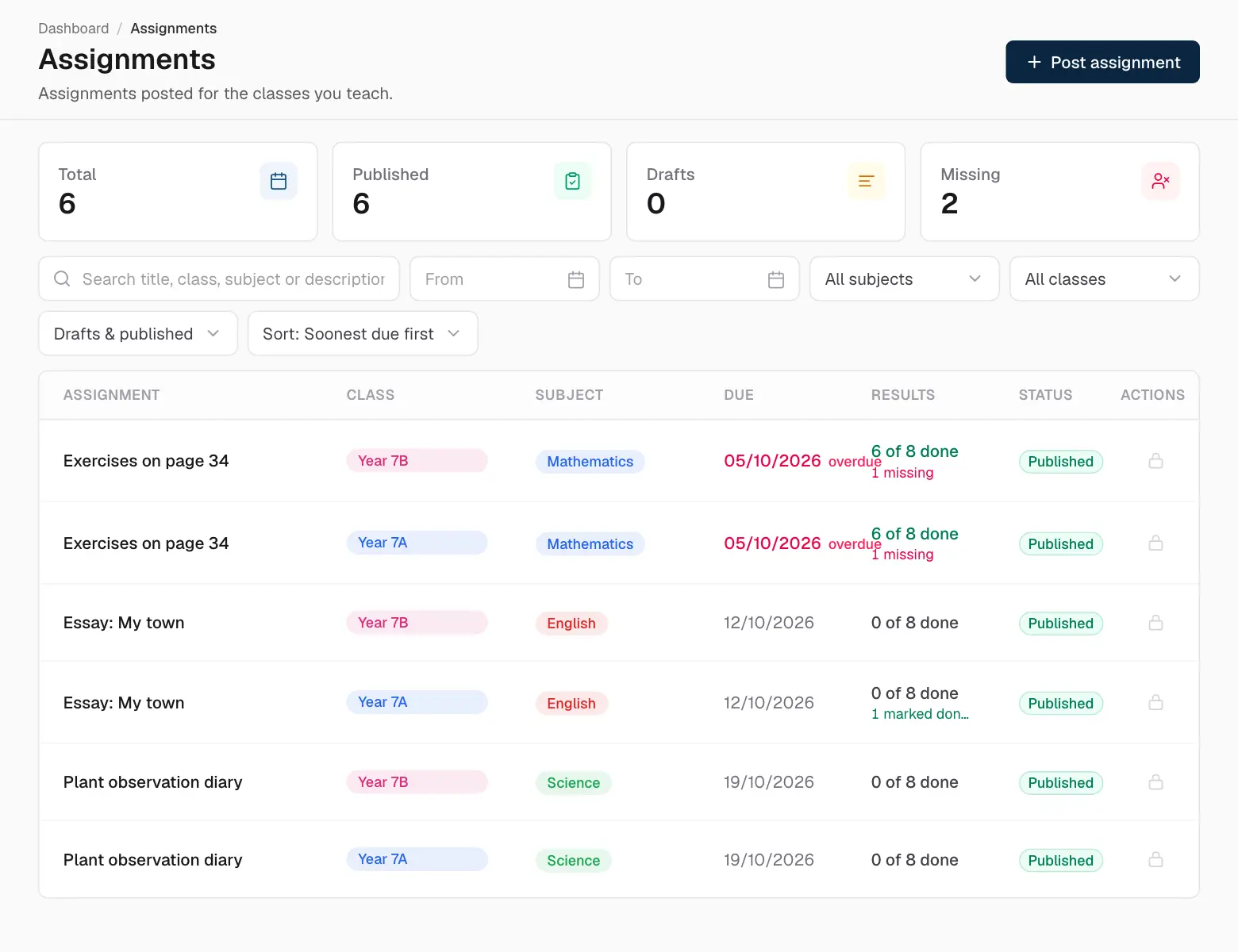
On Assignments, click Post assignment.
Choose the class and subject, write the title and instructions, and set the due date.
Choose Whole class or Specific students — handy for catch-up work.
Click Post assignment. Your students and their parents see it at once.
Your assignments.
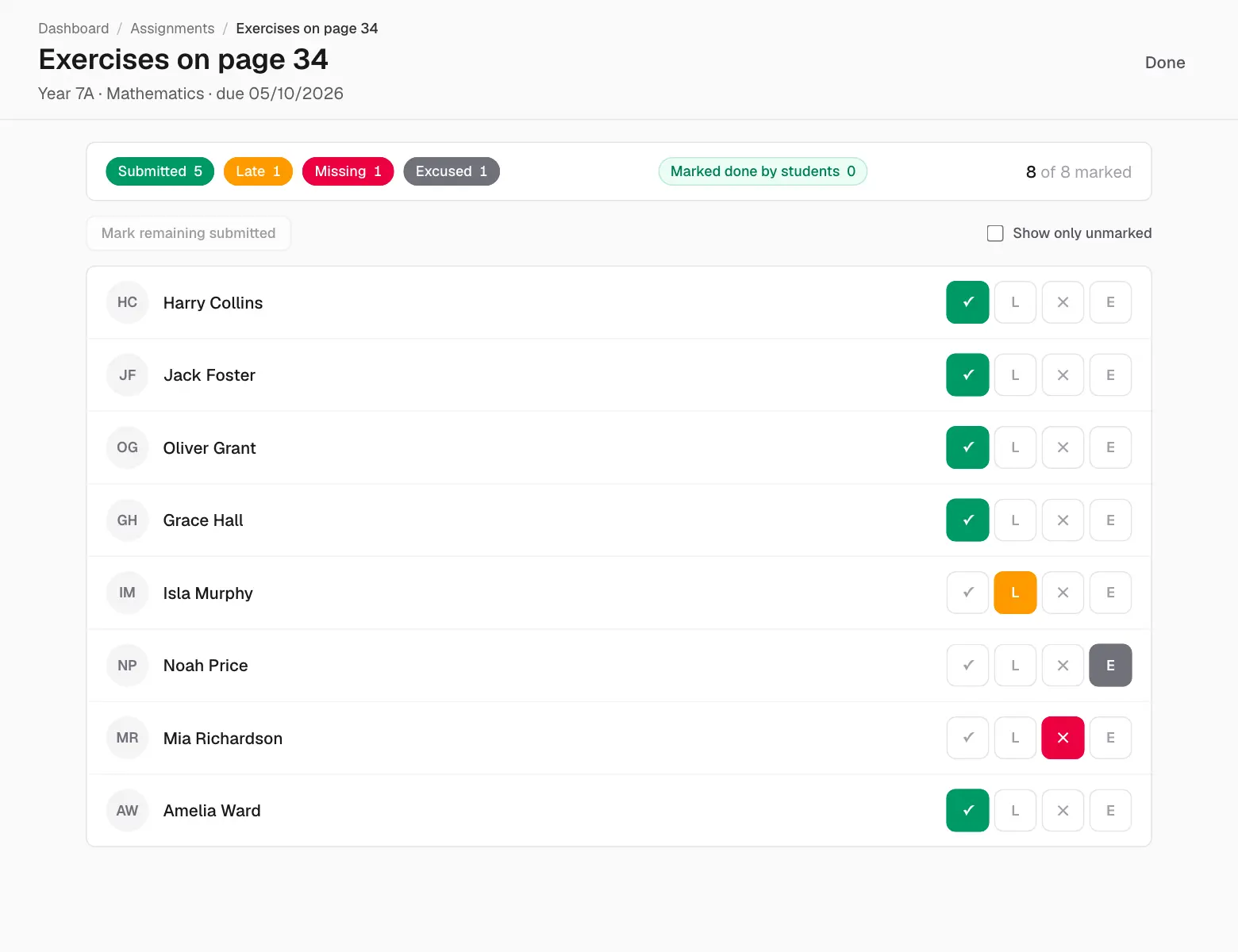
After the due date, open it and mark each student Submitted, Late, Missing or Excused. Mark remaining submitted handles everyone left in one click.
Checking an assignment off.
Behaviour notes
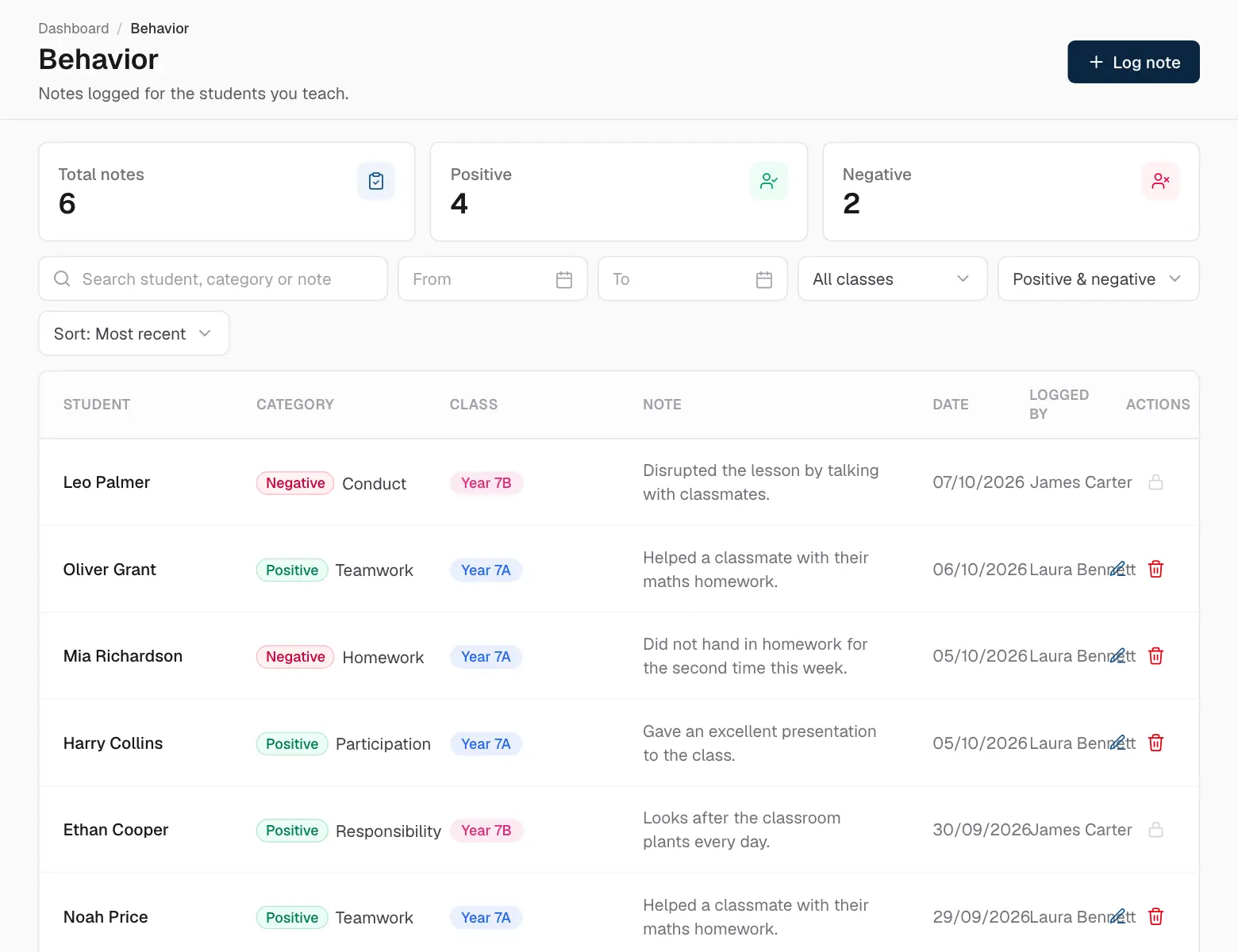
Log a note when something is worth remembering — a great presentation, help for a classmate, or repeated missing homework. The student and their parents see it.
Click Log note on Behavior — or the flag beside a student while taking a register.
Choose the student, Positive or Negative, and a category.
Write what happened and save.
Behaviour notes for your students.
04
Schedule
Your timetable
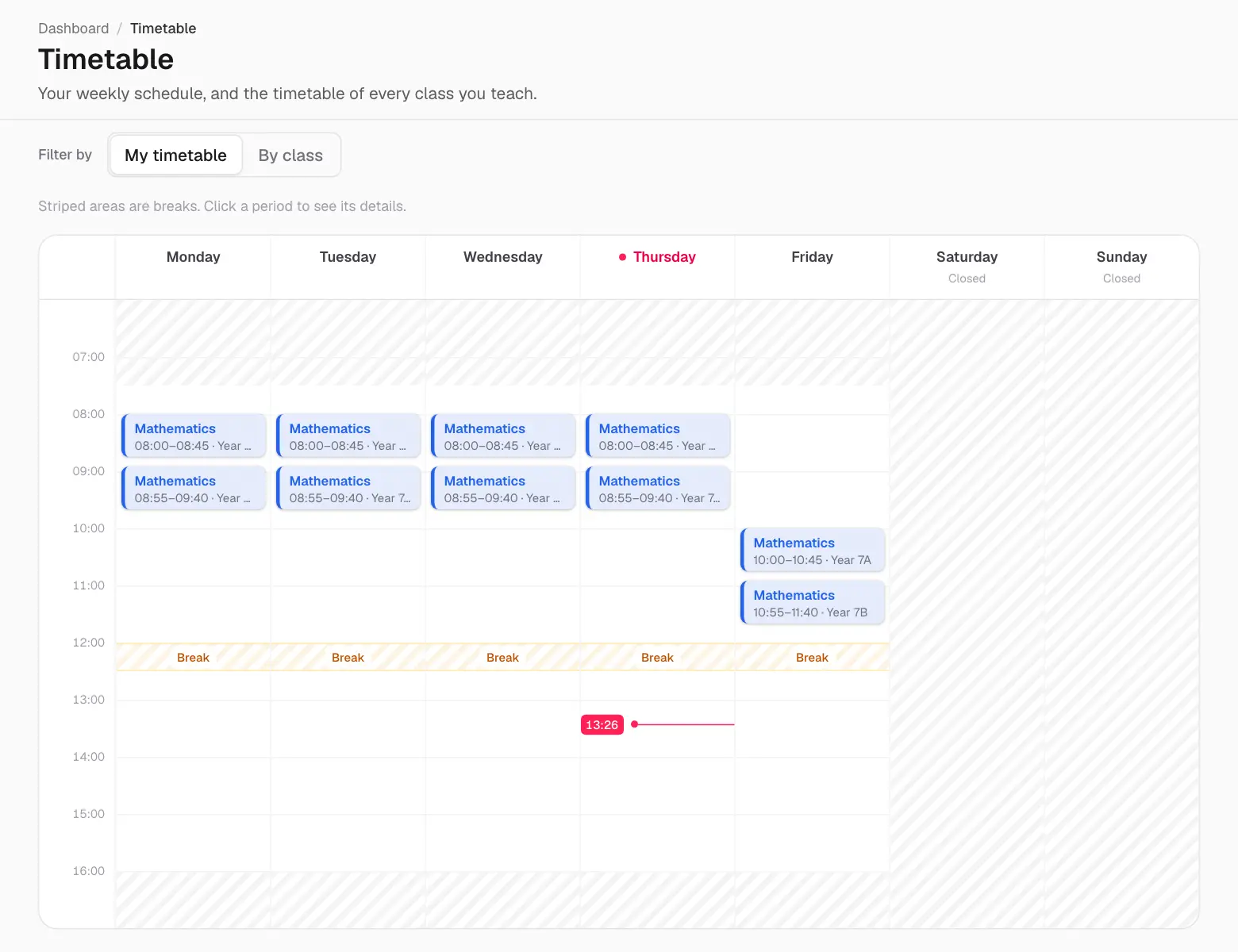
Timetable shows your week: a teacher's own lessons, or a student's class lessons, with subject, teacher, room and time. Today is highlighted and a line marks the current time.
The week at a glance.
Calendar
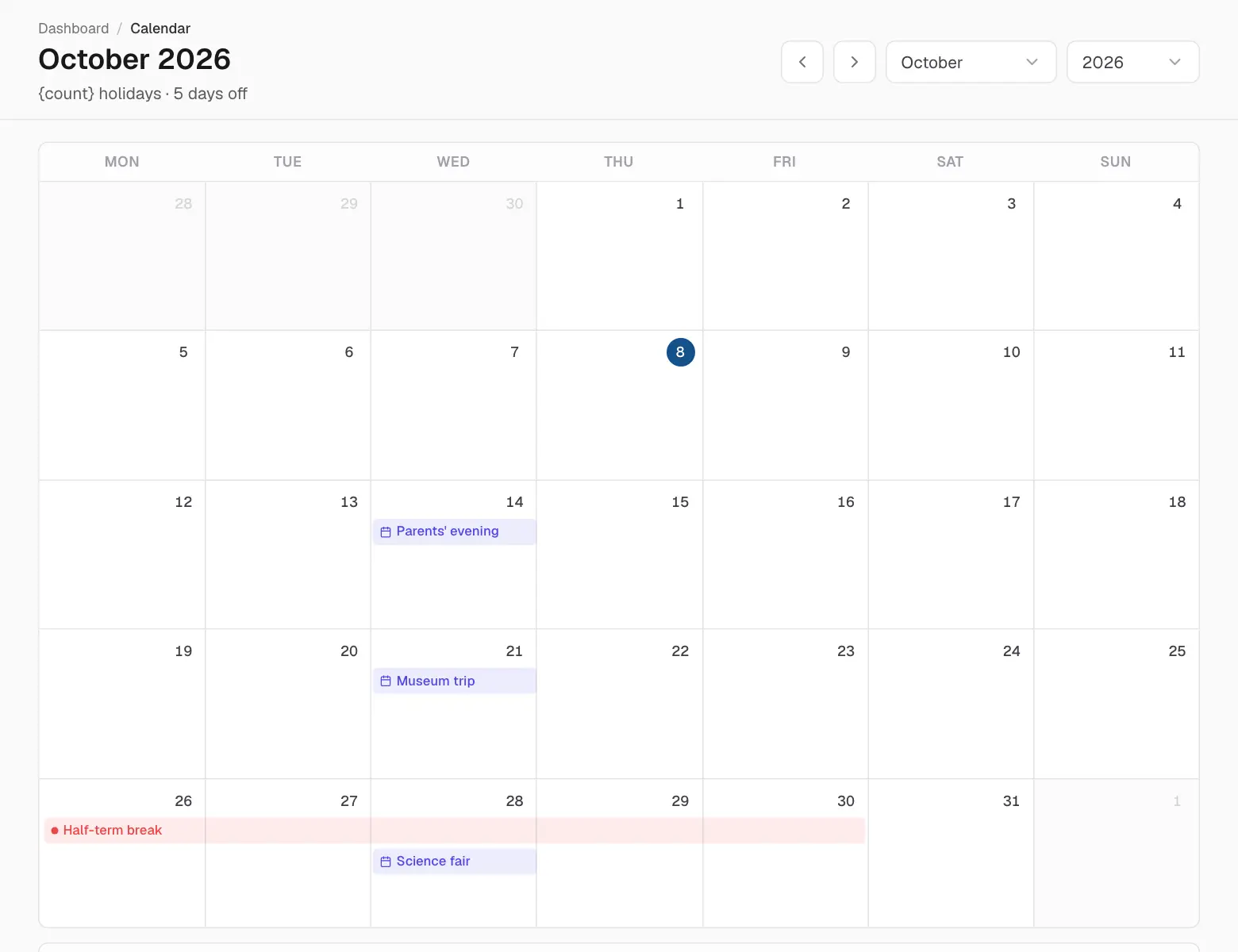
Calendar shows the whole month at a glance: holidays, school events and, for those who manage leave, who is away. Use the arrows to change month and click an entry for its details.
The month calendar.
Events
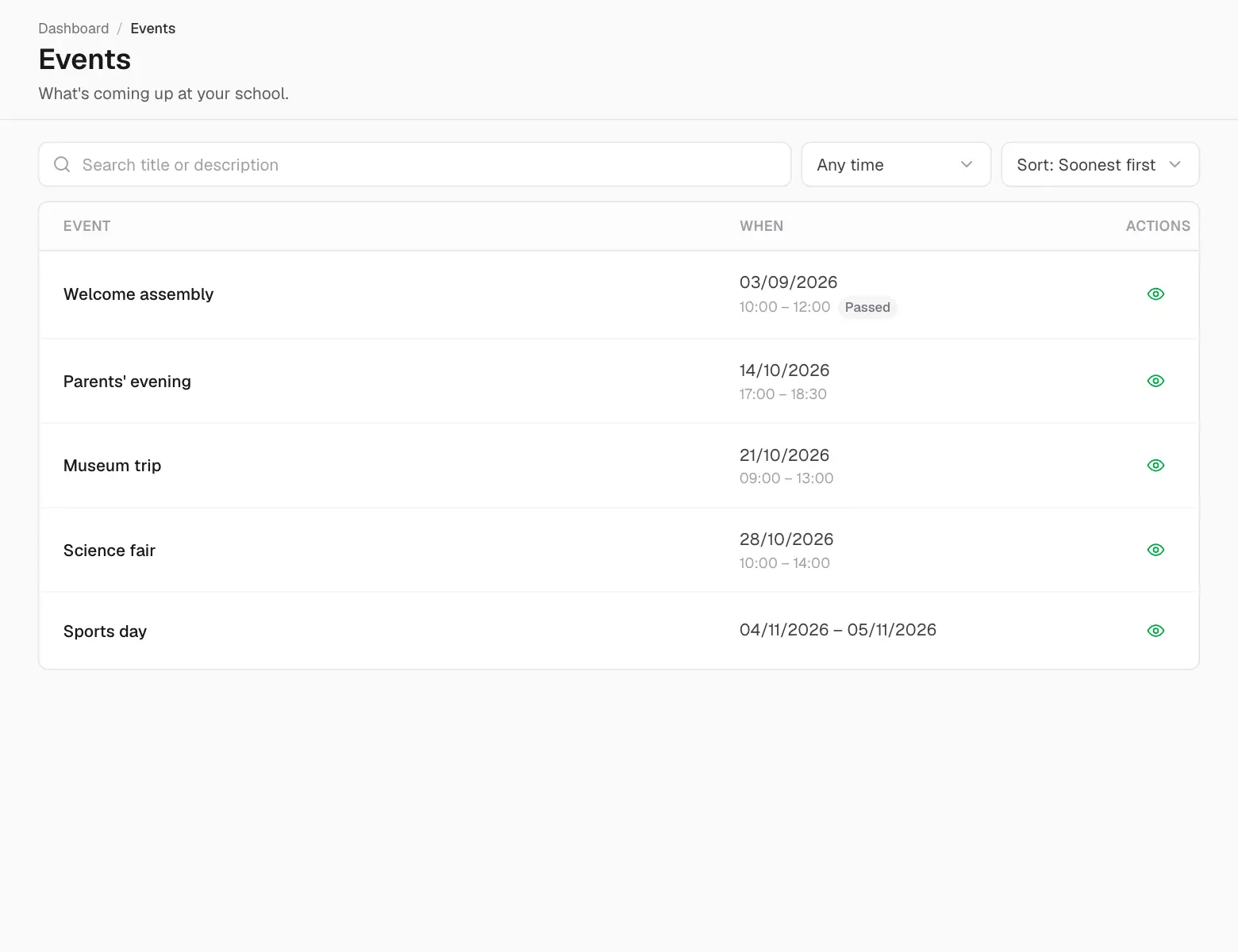
Events lists what's happening at school — parents' evenings, trips, sports days — with dates and times. New events also arrive as a notification.
Upcoming events.
05
Your classes and people
Your classes
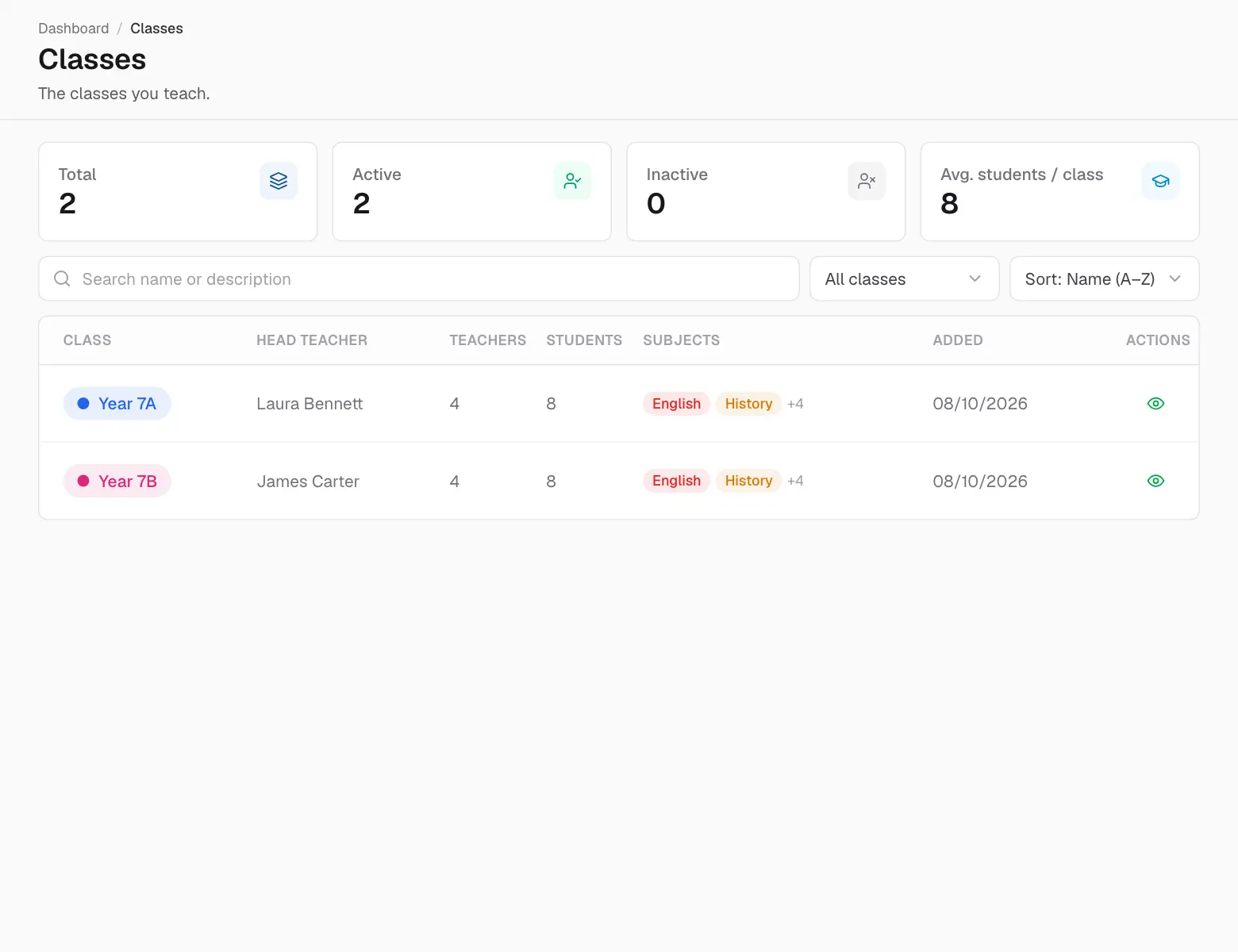
Classes lists the classes you teach, with their head teacher, teachers, students and subjects. Click the eye icon to see the full roster.
Your classes.
Your students and colleagues
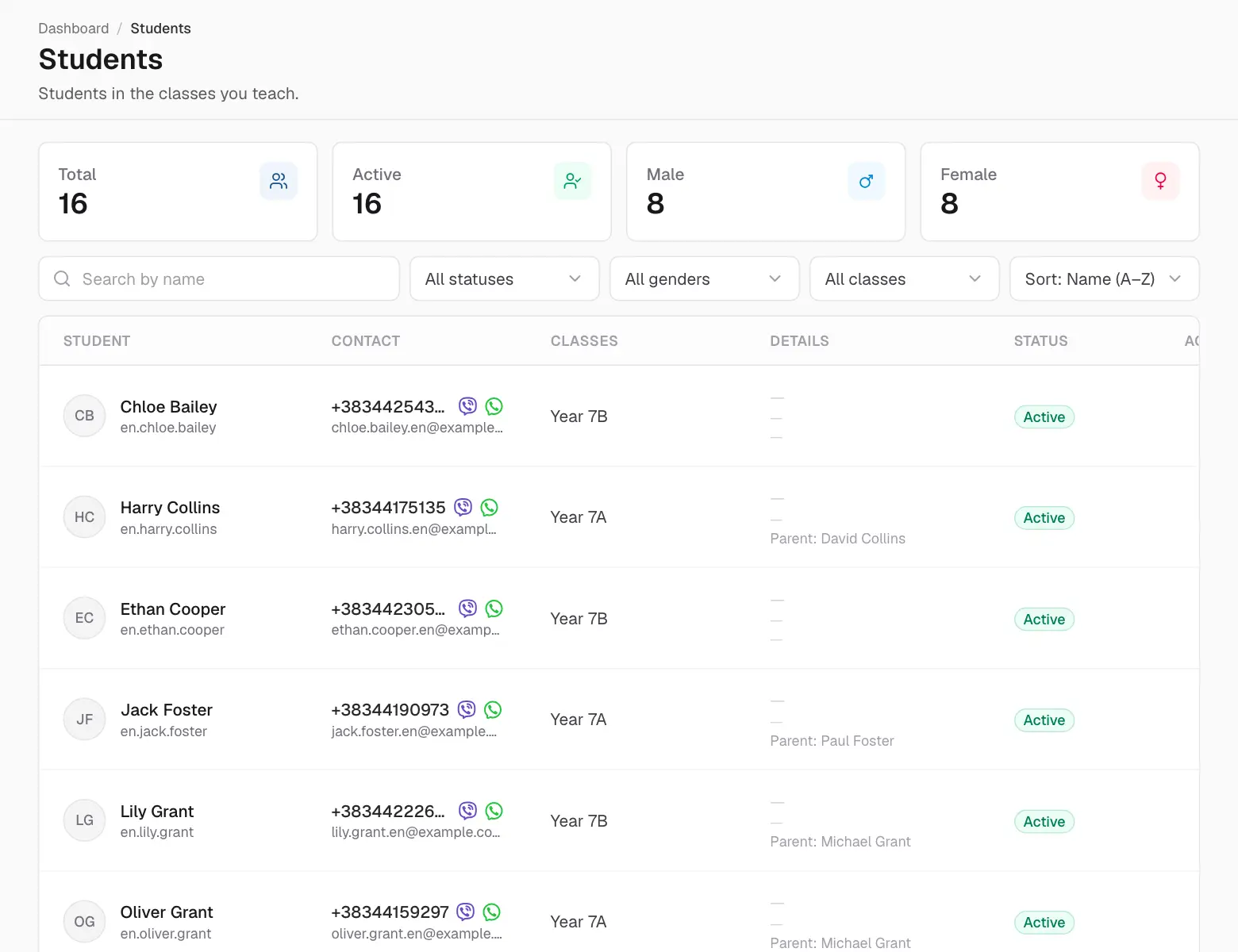
Under People you can look up your students and their parents, and your colleagues. It's read-only; phone numbers and emails let you get in touch straight away.
Your students.
06
School
Documents
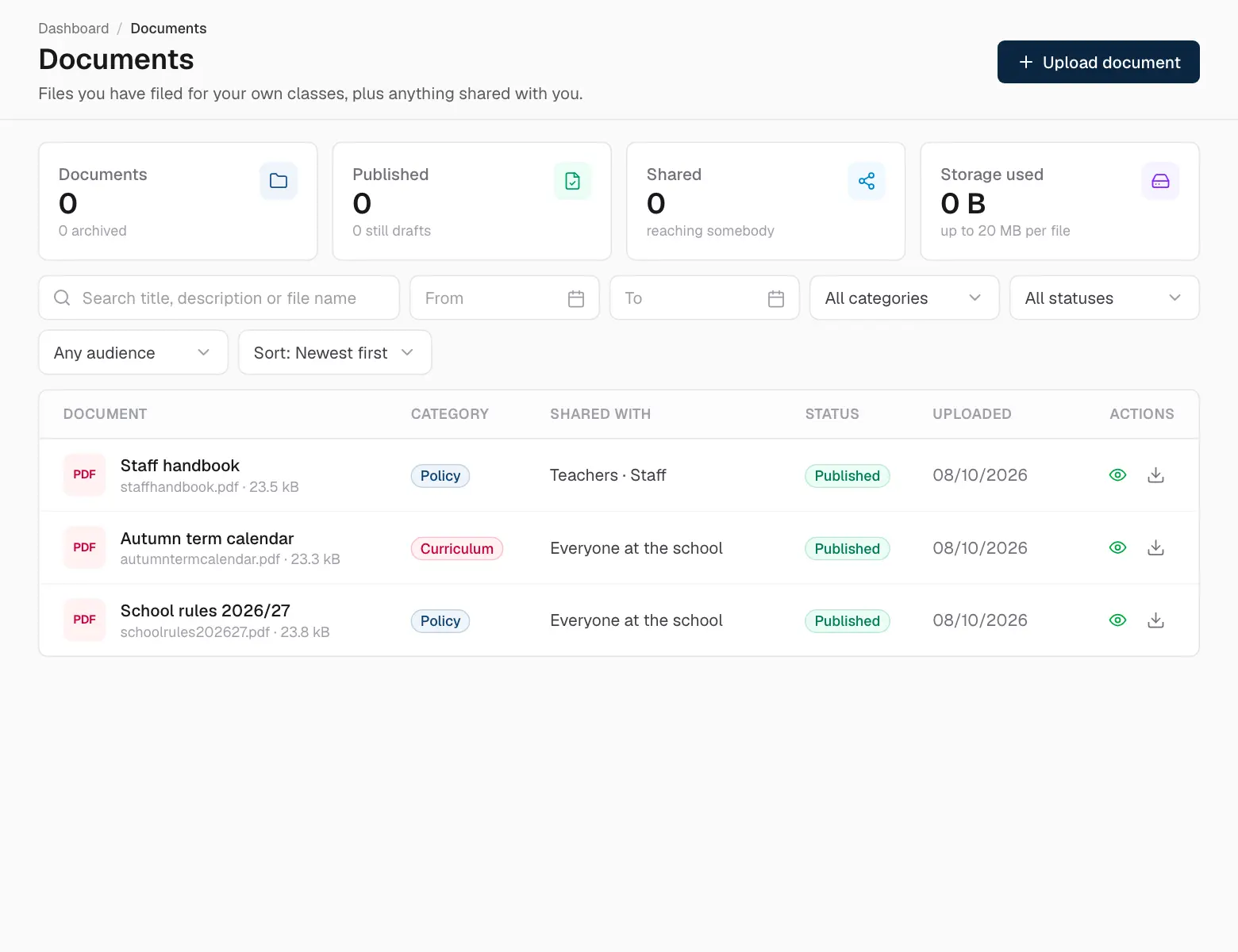
Documents holds the files shared with you — policies, forms, newsletters. You can also upload your own, for example a reading list for your class, and choose who sees it.
Documents.
Click Upload document.
Drag in the file and give it a title.
Under Audience, choose your classes or specific people.
Set it to Published and save.
Vacation and sick leave
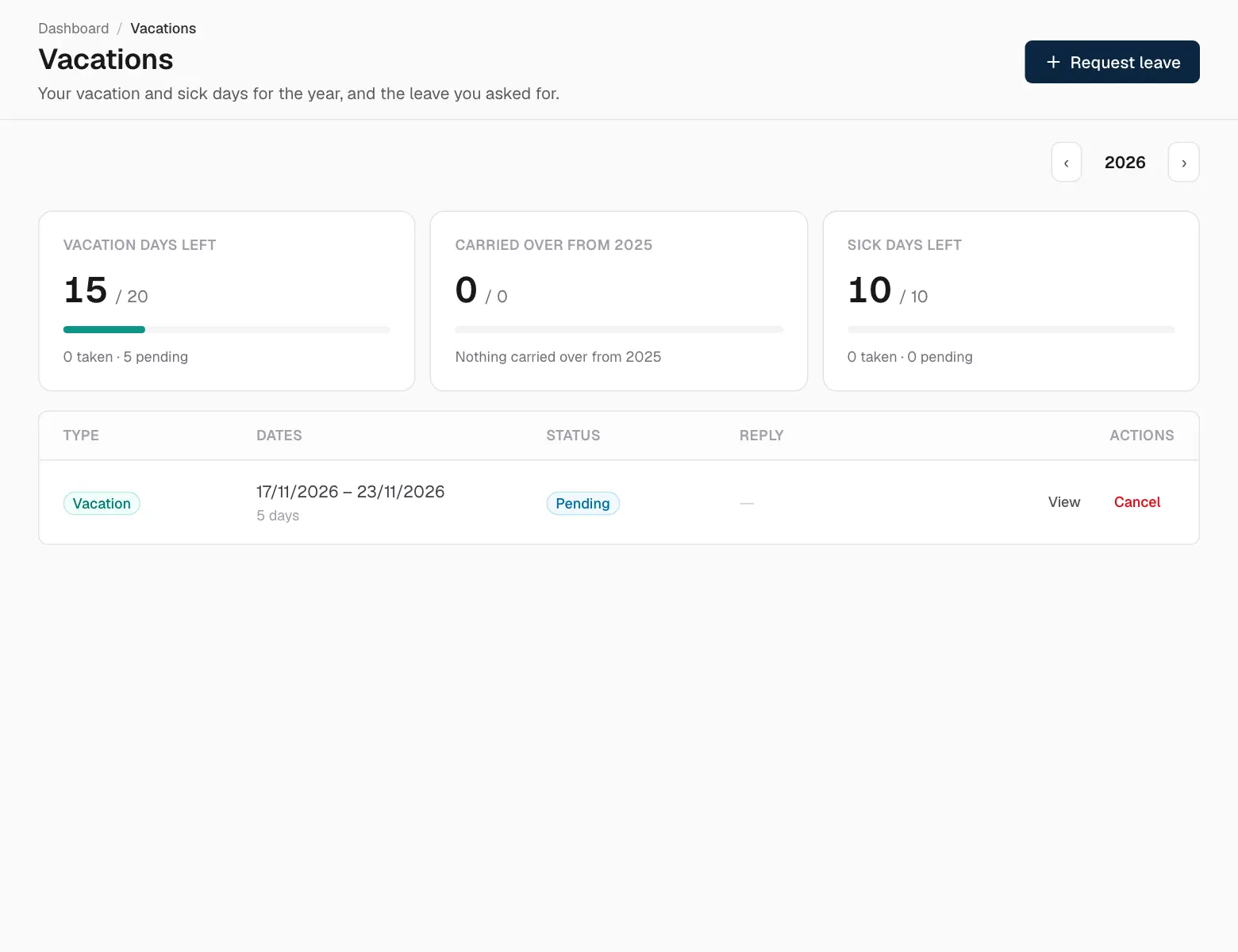
Vacations shows how many vacation and sick days you have left this year, and every request you've made.
Your leave.
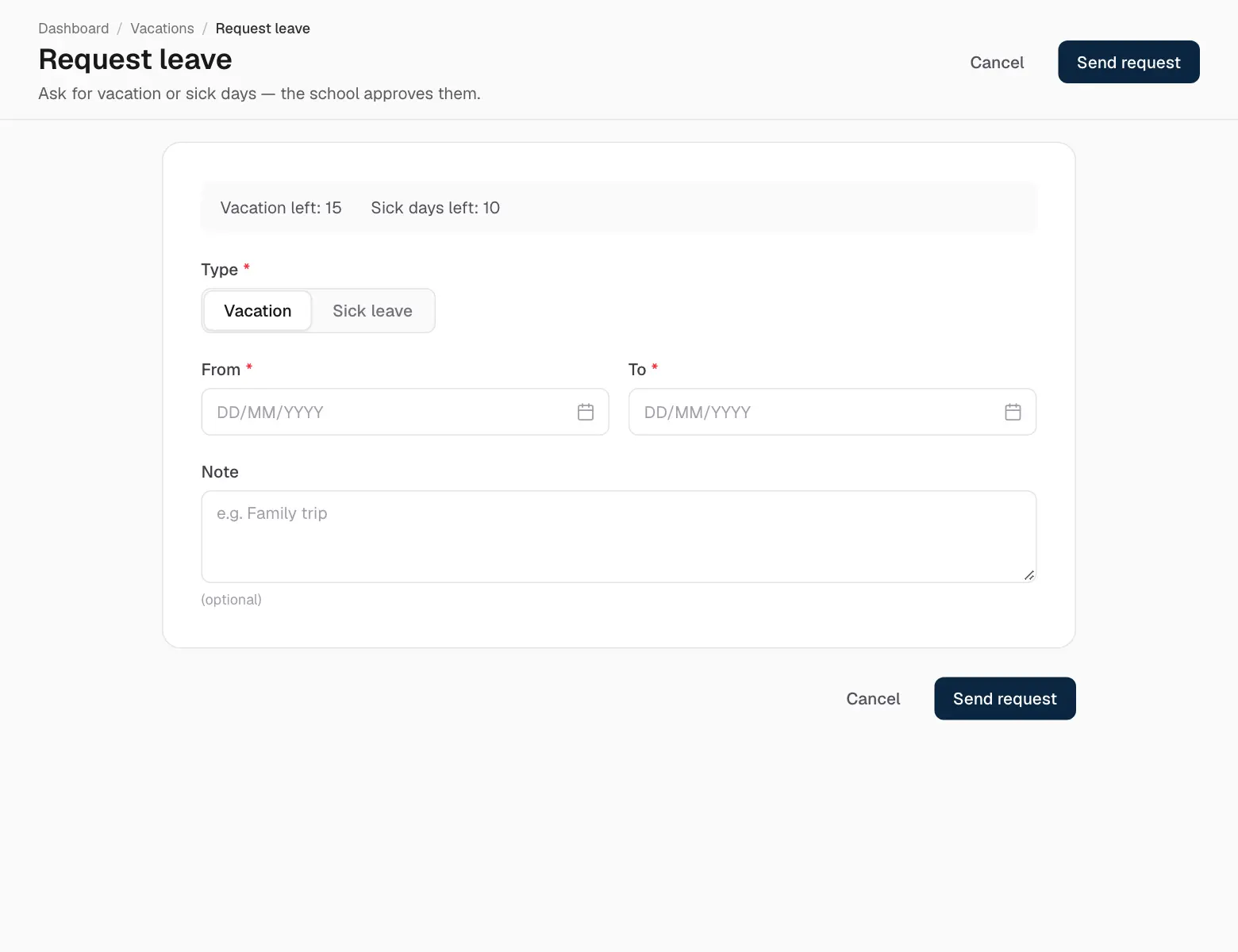
Click Request leave.
Choose vacation or sick leave, the first and last day, and add a note if you like.
Send it. The school gets a notification, and you get one when it's approved or rejected.
Requesting leave.
Holidays and opening hours
Holidays lists the days the school is closed, and Opening hours when it's open each day. Holidays also appear on the calendar.
07
Messages and notifications
Messages
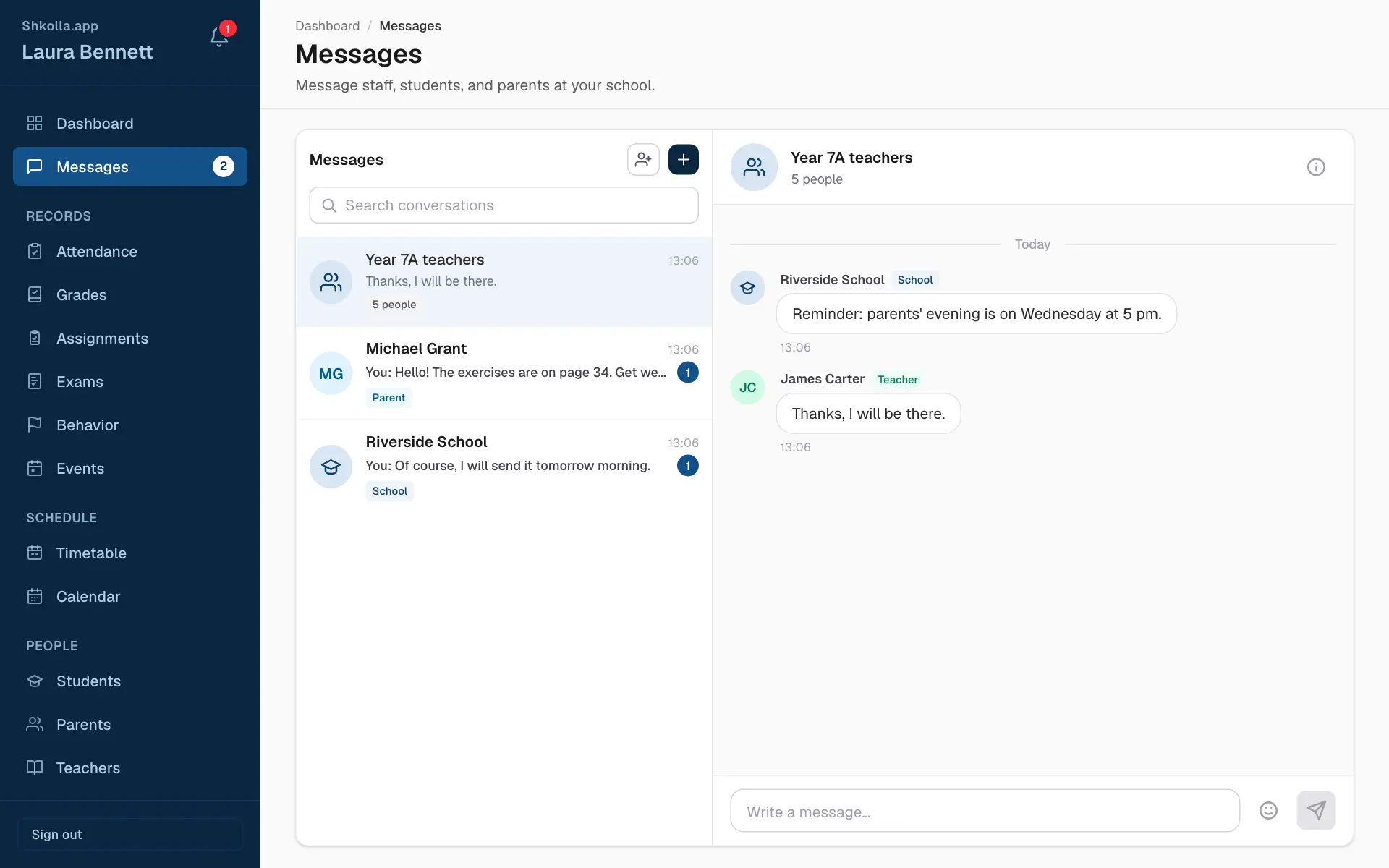
Messages is a private chat for your school community.
Messages.
Click Messages in the sidebar.
Click + (New message) and choose who to write to.
Type your message and press Enter.
Your conversations are on the left; a blue number counts unread messages.
You can only message people you're connected to at school — for example your teachers, your classmates, your children's teachers and the school office.
The school, teachers and staff can also start a group with New group chat — handy for a class's teachers or a committee.
Notifications
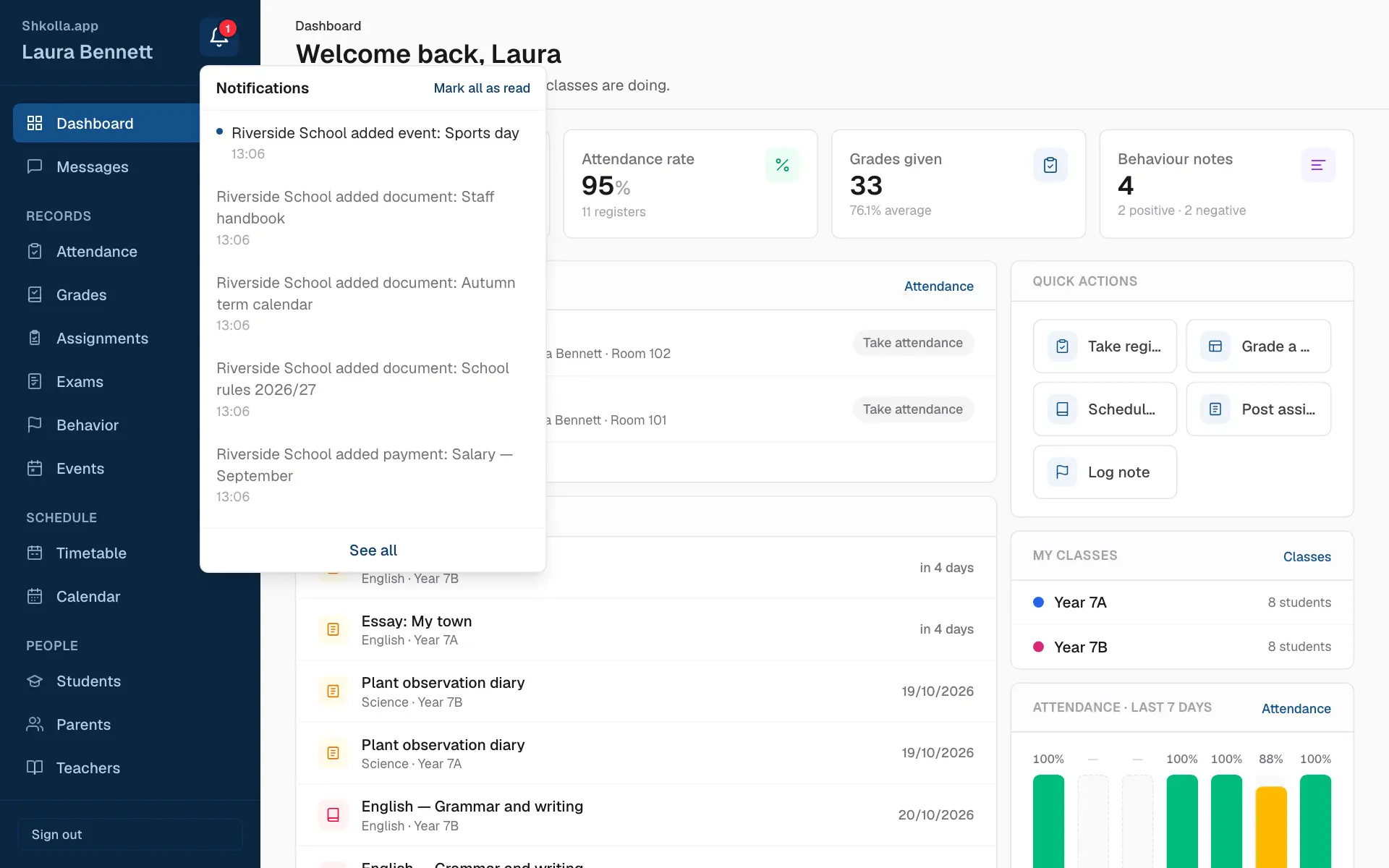
The bell at the top of the sidebar tells you when something new happens — a grade, an assignment, an event, a leave request…
Your latest notifications.
Click the bell to see the latest, and click one to open it.
Mark all as read clears the red badge.
See all opens the full history.
08
Your account
Your profile
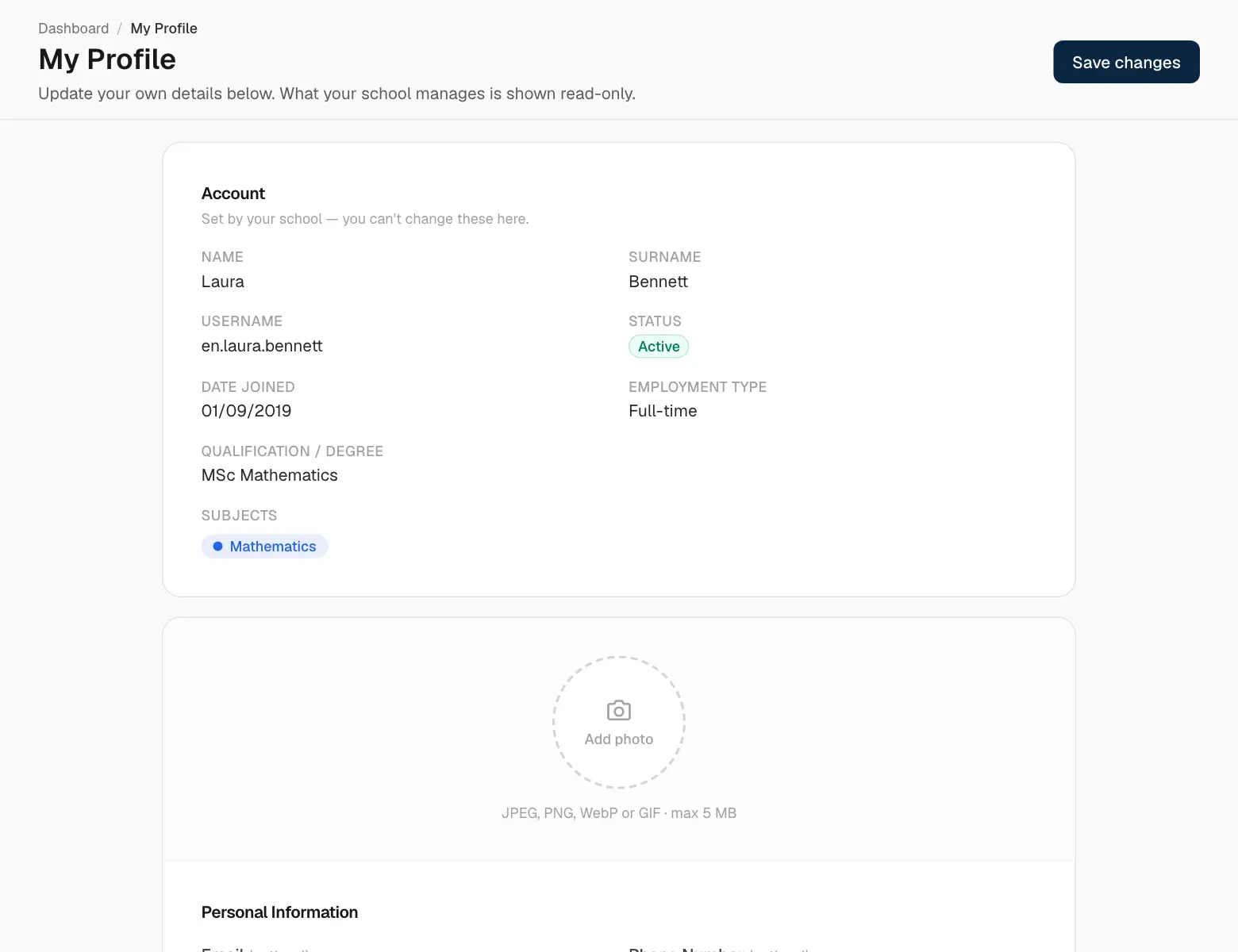
Profile is your own record. Add a photo and keep your email, phone, birthday, nationality, address and short bio up to date. Your name, username and school details are managed by the school — ask the office if something's wrong.
Your profile.
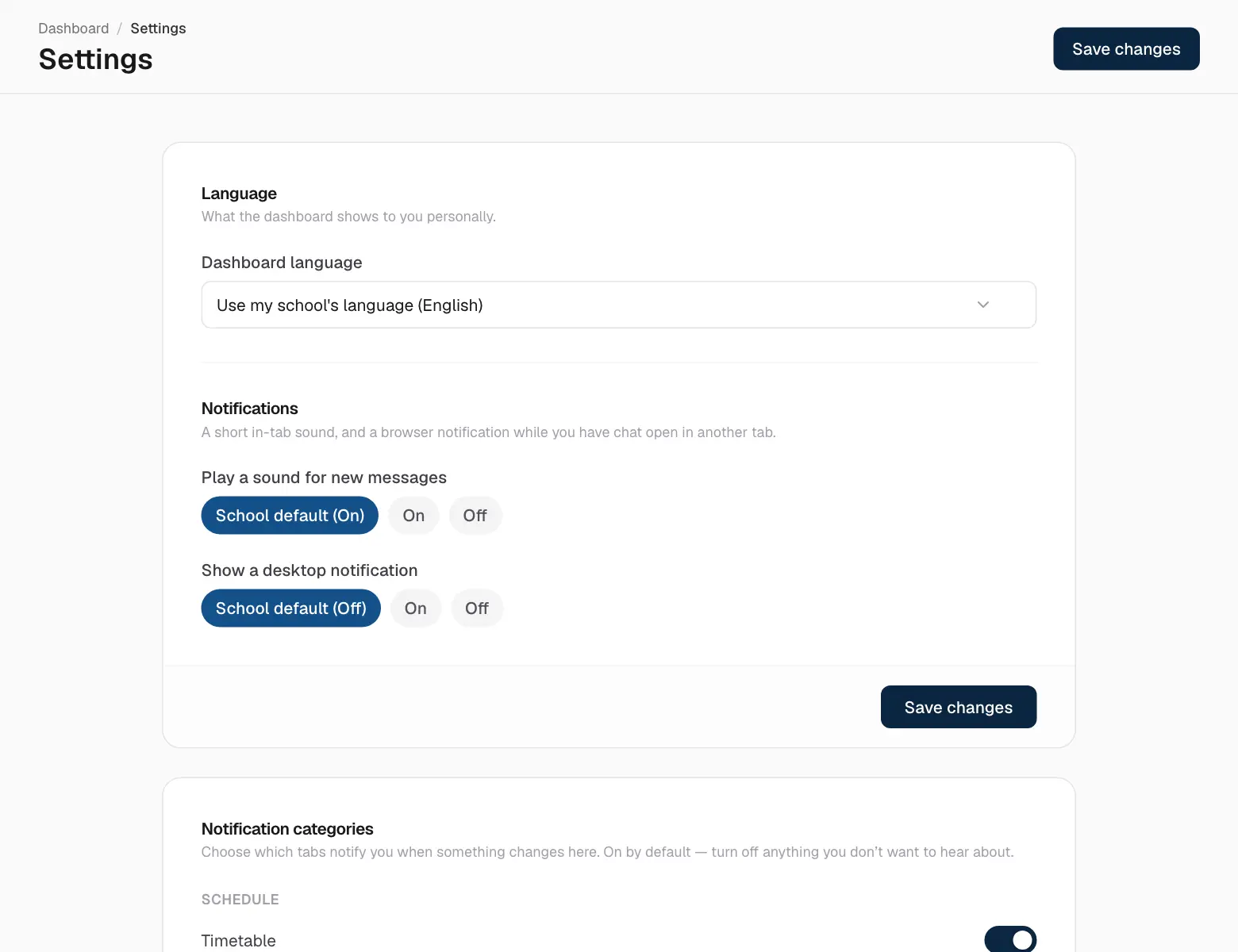
Your settings
Your settings.
Language — the app's language, just for you.
Notifications — switch notifications on or off for each tab.
Account — change your password, or sign out of every other device if you forgot to sign out somewhere.
09
Questions and answers
Questions and answers
A student is missing from my register. The school office manages classes — ask them to add the student.
I marked the wrong student. Just click the right mark; the register saves the change.
Can parents see my grades straight away? Only published ones. Save as Draft to keep a grade private for now.
Do students see exam results immediately? Only after you click Save & release results.
I forgot my password. Ask the school office to set a new one.
 Shkolla.app